If you work in or around data centre networking, you've probably noticed that the conversation around multimode fiber (MMF) has been picking up again. And honestly, it's about time. With AI data centres fundamentally reshaping how we think about network architecture, the role that MMF plays and, just as importantly, where it doesn't play deserves a fresh, honest look.
We've been watching these trends closely for some time now, and two things stand out above everything else: link length and power consumption. Get those two factors right, and the rest of the MMF story starts to make a lot more sense.
Link Length Trends: The Shifting Ground Beneath MMF
How AI Data Centres Are Redefining MMF vs SMF Boundaries
Let's start with the numbers, because they tell an interesting story. Over the past decade, MMF's share of the data centre fiber market has been on a steady downward slope dropping from roughly 80% in 2015 to around 40% by 2025.
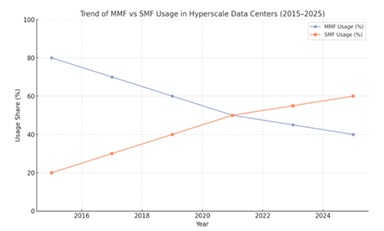
Three forces have been pushing this change in the data centre fiber landscape:
- link length inside data centres is changing and not in MMF's favour
- DR4 optics and FR4 optics are gaining traction, pulling deployments toward single mode fiber (SMF)
- The cost gap between SMF and MMF optical transceivers has narrowed
Traditionally, multimode fiber was the go-to choice for anything under 100 metres. Single mode fiber took over beyond that. But that boundary has been moving, and today it's closer to 40 metres. SMF is increasingly the preferred data centre fiber choice beyond this threshold.

In a typical hyperscale data centre, you're looking at roughly a 60/40 SMF vs MMF split. MMF still has a meaningful presence, but it's no longer dominant. AI data centres are a different story at least partially. AI clusters are built around enormous numbers of ultra-short connections, many of them under 30 metres, and that kind of topology genuinely favours MMF. The density, the cost, and the simplicity all line up well.
AI clusters are built around enormous numbers of ultra-short connections, many under 30 metres, favoring short reach fiber and optical connection
But here's the catch: those same AI environments still rely on single-mode fiber to connect clusters to each other. When you look at the data centre as a whole not just the GPU clusters the overall MMF percentage doesn't shift as dramatically as you might expect. It's a bit of a tale of two fabrics operating within the same four walls.
The takeaway? Multimode fiber absolutely has a future. But its territory is getting more defined, not less. Its natural home is in super-dense, very short-reach environments generally under 40 metres. Outside of that, SMF is steadily claiming more ground, and it's hard to argue against the trend.
Power Consumption: The Case for SMF at Scale
Power Per Port: MMF vs SMF at 100G, 400G, 800G
If link length is where the multimode fiber story gets complicated, optical transceiver power consumption is where it gets genuinely difficult for MMF advocates to defend the technology at scale. The efficiency gap between MMF and SMF becomes harder and harder to ignore as speeds increase and in today's data centres, speeds are increasing fast.
Here's a straightforward comparison across the three speed tiers that matter most right now:
| Speed | MMF (SR/SR4/SR8) | SMF (DR/FR/DR4/FR4) |
|---|---|---|
| 100G | ~3–4 W | ~2.5–3.5 W |
| 400G | ~10–12 W | ~8–10 W |
| 800G | ~16–20 W* | ~12–16 W |
Those numbers might not look like a huge deal in isolation. But scale it out across a hyperscale data centre, and the picture changes completely. Here's why SMF has the efficiency edge at these speeds:
• Fiber count:
SMF solutions typically use fewer fibers 4 versus 8 to 16 for MMF at 400G and above• Per-port savings:
That translates to approximately 1.5 to 4 watts saved per port at high speeds and those savings compound quickly• Modulation technology:
Direct modulation with SMF outperforms VCSELs once you push above 400G• Next-generation optics:
Co-packaged optics and linear drive solutions are designed around SMF from the ground up
Let's make this concrete. Take a hyperscale data centre running 100,000 optical ports not an unusual number for a large-scale deployment:
- • Running MMF at 400G-SR8 at 10 to 12 watts per port roughly 1.0 to 1.2 megawatts of power just for the optics
- • Switching to SMF at 400G-DR4 at 8 to 9 watts per port down to around 0.8 to 0.9 megawatts
That is a difference of 200 to 400 kilowatts. In a world where data centre operators are fighting over every megawatt of capacity, cooling headroom, and grid availability, that is not a rounding error. It's no coincidence that hyperscalers like AWS and Google have been so deliberate about prioritising SMF for their high-density builds.
Where Should MMF Innovation Focus?
The Business Case for MMF in Short-Reach Fiber Deployments
Here's something that genuinely puzzles us: a fair amount of the current R&D energy around multimode fiber seems to be directed at pushing the technology to higher speeds over longer distances. From a certain engineering perspective, we understand the impulse it's always tempting to push the boundaries of what a technology can do.
But step back and look at where MMF actually lives in real data centre fiber deployments, and a different opportunity comes into sharp focus. The vast majority of data centre links are short. Many of them are very short. The AI cluster architectures that are going to define network demand for the next several years are built on tens of thousands of sub-30-metre connections. That is MMF's territory.
So the question we keep coming back to is: why aren't more resources being directed at making multimode fiber the undisputed champion of that space? Specifically developing short-reach fiber solutions that can reliably deliver 800G and beyond over distances of 40 metres or less, at lower optical transceiver power and lower cost than any alternative.
That's not a consolation prize. That's a genuinely large and growing market. AI infrastructure is scaling aggressively, and the interconnect density required by GPU clusters and emerging accelerator architectures is only heading in one direction. If MMF can lock in that short-reach fiber space with robust, efficient, cost-effective solutions, it has a decade of strong growth ahead of it.
The risk of chasing longer distances and higher speeds outside of MMF's natural operating range is that you end up competing directly against SMF in the data centre fiber market on its home turf and that's a fight that's increasingly difficult to win on either performance or economics.
Final Thoughts: MMF's Defined and Valuable Future
Multimode fiber isn't going anywhere. Anyone who tells you the technology is dying is either not looking at AI cluster architectures or is conveniently ignoring them. The technology has a real, valuable role to play in the modern data centre fiber ecosystem it's just that the role is becoming more specific, not less.
The future of MMF isn't about stretching it into territory where it's fighting against its own physics. It's about leaning hard into what it genuinely does well: ultra-dense, short-reach, high-bandwidth interconnects in environments where link lengths are short and port counts are enormous.
That's not a niche. That's the centre of gravity for the most important infrastructure build-out of the next decade. The vendors and engineers who focus their innovation energy on short-reach fiber and optimising optical transceiver power rather than trying to make MMF into something it was never designed to be are the ones who will define what the next chapter of multimode fiber in data centres looks like.